Wednesday, December 08, 2010

Monday, December 06, 2010

It's Been a While

So it's been a while since I wrote here but I'm going to attempt to pick it up again since I've found myself with greater need to procrastinate.

This semester was a lot more work than I had hoped for and a lot less free time than I desired. I found myself teaching 3 sections of Freshman Biology Lab... and oh the stories that exist now!

Currently, I find myself in-between lab sections trying to tie some loose ends up on a presentation that I'm giving on Wednesday at the Seacoast Chapter Meeting. Here's the blurb about it that was posted online:
This Wednesday, December 8th, Lauren Kras, UNH graduate student and current record holder for finding the most species of birds in NH in a calendar year, will describe her graduate research project which looks at the current status of 5 species of threatened, and endangered tidal plants--and also her 2009 Big Year.  All are welcome to attend the program which will be held at the Seacoast Science Center, Odiorne Point State Park, 570 Ocean Boulevard, Rye. Refreshments are at 7:00 pm. Meetings begin at 7:30 pm.  Hope to see you there!
Maybe some of you will make it... it should be interesting... I hope.

In other news, I recently became president of the Seacoast Chapter. I'm pretty optimistic about the changes/growth that can be made but its frustrating that I get this opportunity at the same time that I NEED to finish my M.S. Thesis... oh well.

I also, turned down an opportunity, which is a big step in fulfilling my need to "manage" my volunteer opportunities and not be over-extended for fear of returning to the over-burdened ways of junior and senior year of college. It's a tough balance but I'm working on it.

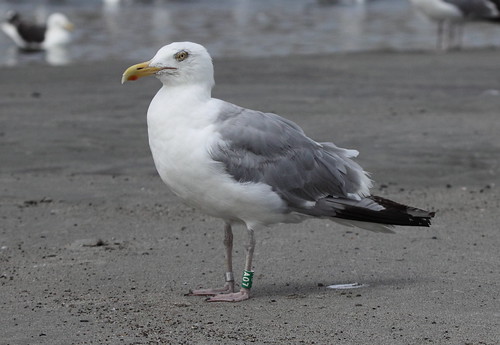
Finally, I've become obsessed with two things lately: (1) taking pictures, and (2) looking for banded gulls...

If you didn't already know, my pictures can be viewed at: http://www.flickr.com/photos/lkras/

And there are even some of banded gulls like this guy right here:
Herring Gull - A07

Saturday, July 31, 2010

Plum Island 7/31

Today I spent some time on Plum Island. Instead of looking for all the rarities that have been seen there lately, I decided I'd look at some of the common things in a little more detail.

Every fall there are lots of Tree Swallows that Stage on Plum Island. I've never seen it before since last fall I was obsessed with chasing down every rarity in NH. Today, I was absolutely blown away with how the swallows filled the sky. And it's not even to its peak yet!!! Here are some of the birds taking off today.


Not only do they fill the sky but the fill the road too! I wonder how many birders zipped through not bothering to stop and appreciate how cool this was on their way to chase down a Scissor-tailed Flycatcher, Royal Tern, etc.


One of the other neat things I got to see there was this Semipalmated Sandpiper which was actually tagged!!! I like how you can see the reflection and the habitat in the photo instead of a full frame shot. It may not be field-guide worthy, but I didn't have to flush any birds and it shows a different side of the birds that is often overlooked in my opinion.


Finally, I ended the day taking photos of terns and appreciating all the diversity in looks amongst terns this time of the year. You get adults, juveniles, and some making some neat transitions and there is also individual variation! And when you consider that there are 3-4 species around this diversity is quickly multiplied!!!

I didn't get any spectacular shots but I did manage to pull this shot off which shows a Tern diving from the underside... Kind of neat ... but not perfect!!!


Wednesday, July 07, 2010

Seal Island NWR 6/27

So a while ago I went to Seal Island NWR and had a fantastic day. I saw tons of alcids and lots of other neat birds. One of the most memorable things for me had to be a fight I saw between two Razorbills:


Razorbills are closely related to Puffins which also were present on the Island:


I had never seen a Puffin prior to this trip so needless to say I was very excited about it!!! Puffins actually breed on the island and were one of my primary targets for the trip. The number 1 target was a Red-tailed Tropicbird that's been seen on the island over the past few summers.

Unfortunately we struck out with the Tropicbird. But that happens from time to time! You just don't get to see everything.

We did get to see lots of other birds though including Arctic Terns which are not very common in NH. In fact only 6 pairs breed in NH and I've never had such knee-buckling views as I did near Seal Island in Maine:


All in all I had a great time and got to see tons of Puffins, Razorbills, and other Alcids like the Common Murre on the left 1/3 of the photo below. Yes, those are puffins on the rocks to the right!!!


Sometimes its nice to get away and just enjoy something new and different. I've never seen anything like a breeding colony of alcids before and... it was definitely worth the trip. Hopefully one day I'll see a puffin in NH, but if I don't... At least I had the awesome experience of seeing them on their nests!

Saturday, June 26, 2010

A Little Help From My Friends

Hey all! I'm here looking for a little bit of help and no matter who you are you can lend a hand. As many of you may know I'm a pretty avid birder in New Hampshire. I'm also a graduate student so I'm therefore pretty poor. However, I absolutely love going on whale watches to look for birds. It's come to my attention lately that a lot of people cannot make it on long pelagic trips, are unwilling to go offshore for that long, or aren't comfortable going on whale watches themselves. However, there aren't any cheap guides or ways to learn your birds offshore as naturalists must focus on whales not birds.

Finding a mixed flock of shearwaters is very exciting! Yet it can also be overwhelming - particularly when you're trying to pick out the Cory's, Manx, etc. or get a good count on the number of birds in a group.

So I hatched this idea: Trade bird ID help on a whale watch (help people learn birds, identify them for them, help them spot them, etc.) in exchange for them paying for my whale watch. In this way, I get to go offshore and they get to actually learn the birds out there and/or feel confident in their identification.

Jaegers are a great example of confusing birds - can you figure out which species these birds are?

However, there's a few problems - and thats where you come in. I need to know the following things:

1. Would people be interested in this? Most all day pelagics cost between 80-100$ Half day trips aren't run. A whale watch tends to be about 30$ - so it would be about 60$ for a one on one type trip but if a group of people got together it would be substantially less.

2. Is there some sort of tax implication for myself? I wouldn't be receiving money, the person who wanted my help would pay the whale watch company directly and I'd just get on board with them...

3. Is there some sort of liability issue for myself?

Naturally being a poor grad student I can't really pay for legal advise so if anyone knows anyone I can talk to for free I'd be appreciative. If anyone has any insight or ideas I'm also completely game!

Tuesday, June 22, 2010

Appledore Island Gulls

Today I spent my day on Appledore Island to get a feel for the island as I will be TA'ing a class there this August.

Fortunately, I had lots of time to bird and check out the island. There were many highlights including helping to attempt to catch and band the female Herring Gull which has mated with the male Lesser Black-backed Gull on the island. Unfortunately, she never made it into the cage so I was not able to witness this happening.

Female Herring Gull inspecting the nest and the cage trap

This is the 4th year that this Lesser Black-backed has come to Appledore to breed. He was banded along with his mate in 2008 and they both returned in 2009. They raised two chicks one of which has been seen both in Provincetown, MA and in Brevard County, Florida. This year he is with a new mate - hence the need to band her. Dr. Julie Ellis heads up the gull research on the island and has been banding birds on the island since 2004 (with the help of students and volunteers). She also keeps a blog where you can follow the Lesser Black-backed Gull and other gulls: http://gullsofappledore.wordpress.com/

Male Lesser Black-backed Gull: first documented bird to breed in the US

For those of you who don't know... Gull babies are extraordinarily cute. The island is currently overflowing with them. This means their parents are in a very vicious stage! Here's a photo of Great Black-backed Gull Chicks:

Finally, here's a slide show of pictures from the day... all photos can be seen at http://www.flickr.com/photos/lkras/sets/72157624211302151/

Monday, June 07, 2010

June Big Day - 165 Species


On Sunday (6/6) Mike Harvey, Jason Lambert, Ben Griffith, and I attempted to break the June Big Day Record of 151 species which was set in on June 4th 1996 by Pam Hunt and others. We started at Pondicherry at midnight, worked north to Pittsburg and then down to Pawtuckaway, Exeter, and the coast before heading inland to finish up in Durham and Newmarket. We stood at 165 species at 8:30 PM when we gave up all hope of finding nocturnal species as the winds were so strong that we could barely hear each other. Our biggest misses other came from two “groups” of birds: nocturnal species and raptors due to winds at night and the near-constant rain during the day. In fact we missed all of the following: Barred Owl, Great Horned Owl, Eastern Screech Owl, Sora, Common Nighthawk, American Woodcock, Peregrine Falcon, Bald Eagle, Red-shouldered Hawk, Broad-winged Hawk, Sharp-shinned Hawk, and Mississippi Kite. While we wouldn’t expect to get ALL of those we felt as if we should have been able to scrape a few more of these if there had been better weather. Our highlights included a singing Northern Saw-whet Owl, a flock of 11 White-rumped Sandpipers, and 2 species of Shearwater (Sooty and Greater) from shore. A long full day summary is below for those interested.

Our entire species list can be seen at:
http://spreadsheets.google.com/pub?key=0AsqHpuIn-sf7dG56d0d2bGlfaTYzV0hFN1FVRi0yQkE&hl=en&single=true&gid=0&output=html

This team photo and other photos can be seen at: http://picasaweb.google.com/lauren.kras/BigDay?feat=directlink--

Full rundown of the day:

At 12:00:01 AM Mike Harvey, Jason Lambert, Ben Griffith and I (Lauren Kras) stood on railroad tracks in Whitefield, NH listening intently for American Bittern. We heard frogs, the wind, the low hum of a nearby mill… but no Bittern. We had driven up to Whitefield the afternoon before and had a Bittern calling from a distance so we were disappointed. Trying not to waste too much time we decided to cut our losses and walked down the tracks to the Airport Marsh where we picked up our first bird of the day: Pied-billed Grebe. While listening we also picked up our first Swamp Sparrow and Common Yellowthroat. We then went off to Whipple Rd. and were rewarded with a Northern Saw-whet Owl which sang incessantly and a Whip-poor-will which responded to tape and called once (Seen by L. Kras and heard by L. Kras and B. Griffith). At 1:05 AM we took off for Pittsburg, NH. 8 Moose, 7 Fox and 1.5 Jumping Mice later we had arrived (apparently one of the mice didn’t jump far enough to count, and there’s some debate whether one was a leaf or not). We stopped at a few spots to listen for Long-eared Owl but only heard Killdeer and Wilson’s Snipe. Unfortunately the gate into East Inlet was still closed so we began our trek in. We arrived at the Spruce Grouse Track for Sunrise. We didn’t have any Spruce Grouse but we had plenty of Boreal Chickadees, Kinglets, and Yellow-bellied Flycatchers. There was heavy cloud cover and a constant mist as we walked back to the gate. We found a few Bay-breasted Warblers, Tennessee Warblers, and Gray Jays. Mike picked out our first of few raptors for the day: a Merlin perched up which was causing commotion amongst the robins. Once back to the car we headed towards Scott Bog and found a Wilson’s Warbler, Lincoln’s Sparrow, Black-backed Woodpecker, Olive-sided Flycatcher on the way. Near the bog we picked up Philadelphia Vireo, Spotted Sandpiper, and Common Merganser. We headed down to Magalloway Rd. for Mourning Warbler and had a Yellow-bellied Sapsucker on the way. We then drove down to Tabor Rd. and were giddy over a Green Heron which flew over. At Tabor Rd. Ben spotted a Bittern flying over the field while we were there. We all got on it just in time and then zipped down to pick up the Cliff Swallows that nest there.

From there we headed back to Whitefield Airport and spotted Wild Turkey on the way. At the airport Jason picked out a Northern Harrier. Everyone got on it quickly except me. I ran as fast as my short little legs could carry and finally got up high enough that I was able to see over the mound ahead of me and got on the Harrier. We also nabbed Eastern Meadowlark and Bank Swallow.

We then headed down 93 making stops for gas, bathrooms, and a $1.99 chocolate chip whoopee pie for Jason. Jason and Mike spotted an Indigo Bunting at an Irving and Dunkin Donuts provided an Eastern Kingbird. As we started driving we realized that I had left off Indigo Bunting on our checklist (despite including 2 species of phalarope, Jaeger sp., and all 4 shearwaters). Bonus bird behind us we were rejuvenated despite the fact that the rain and clouds took away any chance to spot raptors for most of the drive. Fortunately, when we hit Concord the rain began to clear so we headed directly to Pawtuckaway rather than birding in Concord hoping to get as many southern woodland birds as quickly as possible. The clearing of the rain provided our first looks at Turkey Vulture in Concord and despite his best efforts Mike finally saw a Pigeon.

When we arrived at Pawtuckaway we zipped to the powerline cut and got the usual birds while playing tape and taking a bathroom break simultaneously. We also had a Wood Duck flying over the powerline that Ben first spotted and our first Blue Jay of the day which got everyone excited. We skipped the Cerulean Warbler stop in order to maximize time to search for the other species. The powerline provided the usual birds as did the wooded areas. We got most of the birds we needed quickly including Black-capped Chickadee (cough cough), Pine Warbler, Louisiana Waterthrush, Yellow-throated Vireo, Eastern Wood-Pewee, Veery, and Scarlet Tanager. Just as we had finished our run the rain started pounding on us so we left in favor of Exeter and the Coast. The weather passed and a brief stop at the treatment plant provided us with a Downy Woodpecker (which we couldn’t bear to miss), Warbling Vireo, and Marsh Wren. We then realized that we were about to get pounded with rain again so we headed to the coast in fear that the weather would decrease visibility fast. There weren’t many birds in the harbor but we were able to get Roseate and Common Terns, and Bonaparte’s Gulls. Shorebirds were limited so we ran over to Seabrook Beach to pick up Piping Plover, make a scan, and then come back to the harbor when the tide was a little higher. There we picked up Wilson’s Storm-petrel and Mike spotted our first of at least 3 Sooty Shearwaters. There were clouds of gannets offshore and it was tempting just to scan but we headed back towards the car and harbor. We arrived at the at the public parking area at Seabrook harbor just in time to pick up a few shorebirds including Short-billed Dowitcher and a flock of what we assumed were Dunlin. None of us saw dark bellies so we repositioned ourselves to get them in a scope from the fishing pier. As we pulled in the downpour began. Mike remarked “can’t imagine a better place to be right now” and I took this to mean “we better get out there and scan”. Before I drowned Mike tapped on the car window at me and I saw how hard they were laughing and dove back into the car. I thought they still looked fine for Dunlin but that I couldn’t really see much of anything given the weather. It passed quickly and we were able to get a scope on the birds and proceeded to change the identification multiple times before realizing that they were a flock of White-rumped Sandpipers! Meanwhile Jason spotted a Laughing Gull and the tide continued to rise.

We then ran up to Hampton Beach SP and scanned the Jetty for any Dunlin or Ruddy Turnstones with no luck. Suddenly out of the fog came a boat with tons of gulls following it; I started scanning them when I saw a Greater Shearwater in the midst of them. Unfortunately no one was able to get on it as it flew back into the fog. (I knew there was a reason to keep shearwaters on our checklist!!!) We kept going north up the coast and picked up White-winged Scoter on North Beach, a female Long-tailed Duck at Bicentennial, and Mute Swan at Eel Pond. The weather cleared and we hopped out at Odiorne for Orchard Oriole and Black-crowned Night-Heron without luck but did pick up Nelson’s Sparrow in the marsh. We then headed to Pease one bird from tying the record of 151. At 5:42pm we stopped at a light and saw a crow on a wire and rolled down our windows hoping it was a Fish Crow since we hadn't had one yet. No luck but as the light turned green I heard “peter-peter-peter”… TUFTED TITMOUSE – I hollered and everyone confirmed and we realized we had tied the record.

At Pease we added Upland Sandpiper, Eastern Bluebird, Vesper Sparrow, Horned Lark, Grasshopper Sparrow, and Savannah Sparrow. A trip to Durham helped us add Blue-winged Warbler, Wood Thrush, Blue-gray Gnatcatcher, and Belted Kingfisher. We then zipped down to Newmarket where the blue skies brought about a Raptor flying over Dame Rd. From a distance we all thought MISSISSIPPI KITE so we pulled over and flew out after it only to realize it was an Osprey. A quick trip to Gonet Rd. provided no Yellow-billed Cuckoo but a Red-bellied Woodpecker made up for it. In Newmarket we were able to add Northern Rough-winged Swallow but we struck out with Carolina Wren. We felt as if we were on the edge of being able to make a run for 170 and were debating how to go about it when the wind picked up. We headed down to Lovering Rd. to try for Great Horned Owl and Virginia Rail. The winds were so loud that we could barely hear each other but we did have a Virginia Rail grunting. We hoped that the wind would die down and went to listen for Screech-owls but were disappointed as the winds had only worsened. At which point we decided since three of us had to work the next day and that the other had to pack for a flight that we should cut the night short since we had achieved what we wanted and had learned a lot. We drove back to Concord where we had left cars and all headed our respective ways.

Anecdotal Comments:

The northern route provided for a hilarious opportunity to not see common birds until later in the day (such as Tufted Titmouse). In fact our first...
Jay was a Gray Jay
Woodpecker was a Black-backed Woodpecker
Raptor was a Merlin
Chickadee was a Boreal Chickadee
Nuthatch was a Red-breasted Nuthatch
Finch was a White-winged Crossbill
Corvid was a Common Raven
Thrush was a Swainson’s Thrush

This big day included almost no scouting and planning. The idea to do a big day occurred to me on Wednesday Evening while Jason and I were birding together on Plum Island. We were going to do it together when Ben decided to join and then we asked Mike who jumped right on board. Our planning consisted of a few discussions on ideas during the drive up north to Woodstock. Scouting consisted of one trip to Whitefield between our early dinner and crashing at Mike’s father’s cabin.

Fun Facts:
- Our trip consisted of 490 miles (575 from when I left home until when I returned)
- Over 15 caffeinated beverages were drank in my car
- It was 65 degrees F when we started the day at midnight, it didn't hit 65 again until we were in Rye at 4pm
- This was both Jason and my first "real" big day starting at midnight... he's done the superbowl twice and I've done it once
- This is the most number of species Jason or I have seen in a day
- There are 3 big days with higher totals to my knowledge: 170 on May 27th 1997 (state record), 168 on May 28th 2006, and 167 on May 27th 2004 (unpublished)

FINALLY, I want to say a little bit about the "environmental impact" of our big day. I (and the others) are very aware that driving all over the place is not exactly the greatest thing for the environment. It is even more apparent now as we look at the oil spill in the gulf. While its truly great that people are coming together to try to fund clean up efforts and bird care efforts but I believe that we should all remember that as long as we drive, heat our homes, and consume oil it is likely that oil spills will keep occurring. So every rare bird we chase, every big day we attempt, every bird tour we go on in other countries promotes oil companies to keep drilling - and no matter where they drill it will negatively impact birds. Therefore, as a team we decided to offset the carbon emissions from our big day. While offsetting doesn't take away what emissions we created and doesn't prevent the need for oil, we do think it is better than nothing. We've chosen an organization that does offsetting which focuses on helping non-profits and other such places in converting to 100% green energy in order to help us relieve some of the oil dependence in this country. For those interested in carbon offsets and carbon offset options a helpful link is:
http://www.grist.org/article/gies2/.